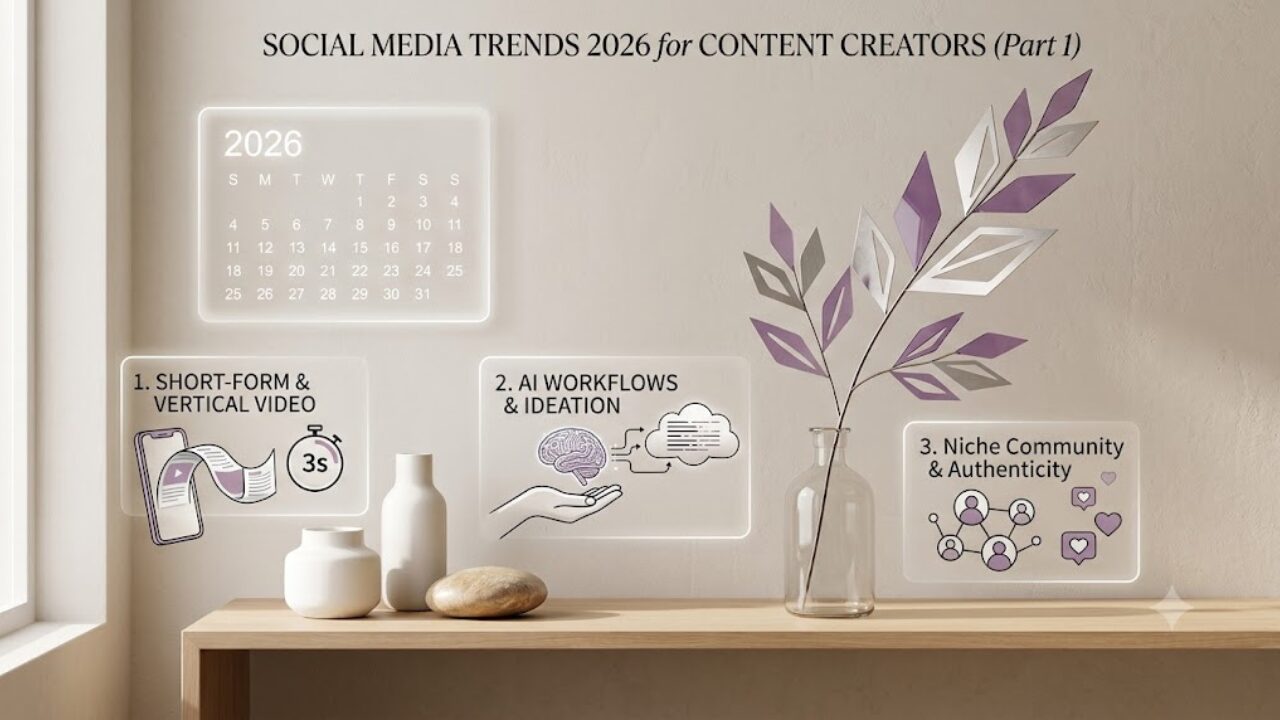
Social Media Trends 2026: For Content Creators (Part 1)
If you create content for a living—or you’re trying to—2026 has already thrown a lot at you. Algorithms keep shifting. Audiences keep getting pickier. And every platform seems to want something slightly different from you this year.
Here’s the good news: once you strip away the buzzwords, a few clear patterns emerge. Viewers want realness over polish. Platforms want you to build community, not just chase views. And AI is everywhere, but the creators who win are the ones who use it without letting it flatten their voice.
Let’s break down what’s actually working right now on YouTube, Instagram, and Facebook.
YouTube:
YouTube spent the last few years pushing creators toward Shorts. In 2026, the pendulum is swinging back. Long-form video is making a real comeback, and creators are leaning into it alongside their short clips instead of choosing one over the other.
The algorithm itself has changed its priorities, too. It’s no longer just rewarding whoever keeps people watching the longest. Now it factors in how satisfied a viewer feels after the video ends. A tight five-minute video that leaves someone genuinely happy can beat a rambling twenty-minute video that loses people halfway through.
You’ll also notice thumbnails and titles getting simpler. Creators like Sam Sulek built massive audiences by ditching flashy edits for raw, unfiltered footage, and that “unpolished” look is spreading across niches. At the same time, AI tools are reshaping production behind the scenes, handling editing, dubbing, and repurposing so creators can publish faster. Auto-dubbing in particular has become a quiet superpower, letting creators reach Spanish, Hindi, Arabic, and Portuguese-speaking audiences without changing a single thing about how they film.
Money is also moving beyond ad revenue. Creators are building their own product lines, merchandise, and even original animated shows, treating their channel less like a hobby and more like a media company.
The takeaway: Post across formats, keep it real, and think like a business owner, not just an entertainer.
Instagram:
If you’re still obsessing over likes on Instagram, it’s time to stop. The platform now weighs DM shares three to five times higher than likes when deciding how far to distribute a Reel. When someone sends your video to a friend, Instagram reads that as a trust signal, and trust is what gets you in front of new people.
Content is also getting rougher around the edges, on purpose. The “YAP” format—unscripted, off-the-cuff selfie videos with minimal editing and simple text captions—has taken off because it feels like a video from a friend rather than a produced ad. Storytime content follows the same logic: hit record, talk like you’re on a call, and let the honesty carry the video.
Carousels deserve more attention than they’re getting, too. Engagement on carousels jumped over 30% compared to last year, which makes them a smart complement to Reels rather than an afterthought. And Instagram’s newer Trial Reels feature lets you test a video with non-followers before deciding whether to commit it to your main grid, which takes a lot of the guesswork out of what to post.
The takeaway: Make content people want to send to a friend, not just double-tap.
Facebook:
Facebook doesn’t get much hype, but creators are returning to it for a simple reason: it pays well for certain long-form content and it still reaches audiences that actually buy things. A local creator with a modest, engaged following can out-perform a much bigger account elsewhere if their audience regularly comments, messages, and shows up for events.
Engagement here looks different than on other platforms, too. A post with 80 thoughtful comments can matter more to a brand than a Reel with 100,000 silent views. Reels remain the easiest path to reach on Facebook, and Meta is clearly trying to keep people from bouncing over to TikTok or Instagram by rewarding native, un-watermarked video. If you’re repurposing a clip from another platform, strip the branding first, or the algorithm will quietly punish you for it.
The takeaway: Don’t sleep on Facebook. Post native video, engage in the comments, and treat it as a community platform, not a content dumping ground.
Thank you for reading and for stopping by. I hope this blog post helps. Enjoy! Stay tuned for part 2. 🙂



Okay. Hmm. I’m taking this in. Tbh, I’ve lost heart with Instagram. I actually like it as a user but not so much as a content creator. But whenever I post on FB, I see the thing where you can post simultaneously on Instagram. I’d like to eventually create YT videos, I’ve done some shorts but not very many. Thanks for the tips. Looking forward to part 2.
I don’t create for a living but you have some very informative information here! Thanks for sharing, I’ll stay tuned for part 2!
I’m very encouraged to hear that realness and community are becoming more valuable than perfect, overly polished content. It’s really hard to get the balance nowadays, especially when everything is so “perfectly AI-d” 🙂