
Wildfire Smoke in North America: How to Protect Your Lungs
The sky above our heads has taken on an eerie, apocalyptic hue. Over the last few days, cities from Toronto to Boston and New York have watched the sun turn a stark, neon orange while a thick, campfire-scented haze settles over the horizon.
This isn’t a scene from a sci-fi movie. It is the immediate, direct consequence of a massive, rapidly accelerating wildfire season.
While wildfires have always been a natural part of the wilderness cycle, the scale, frequency, and reach of these blazes are changing. The biggest danger isn’t just the physical flames—it’s the toxic, invisible soup of smoke drifting thousands of miles into our neighborhoods.
Where the Earth is Currently Burning
Right now, a combination of extreme heat waves and intense dry spells has turned vast stretches of forest into tinderboxes.
The bulk of the current crisis is unfolding across Canada, which is battling over 850 active wildfires. The hardest-hit region is Northwestern Ontario, where dry conditions and sudden lightning strikes have ignited massive blazes, including the colossal Thunder Bay 36 fire. Dozens of these fires remain completely out of control, forcing remote Indigenous and local communities to evacuate their homes.
The border regions are also feeling the heat. In the northern United States, wildfires are tearing through the Boundary Waters Canoe Area Wilderness and Superior National Forest in Minnesota, sending thick plumes of smoke directly into the US Midwest and Northeast.
The Invisible Threat: Why Smoke Hurts So Badly
When a forest burns, it doesn’t just release carbon dioxide and ash. It generates PM2.5—fine particulate matter that is less than 2.5 micrometers in diameter (about 30 times smaller than the width of a human hair).
Because these particles are so microscopic, your nose and throat can’t filter them out. When you breathe smoky air, PM2.5 travels deep into your lungs and can even enter your bloodstream. This triggers immediate symptoms like stinging eyes, coughing, and chest tightness, but it poses severe long-term cardiovascular and respiratory risks—especially for children, senior citizens, and anyone with asthma or heart conditions.
To understand how dangerous your local air is, you need to track the Air Quality Index (AQI).
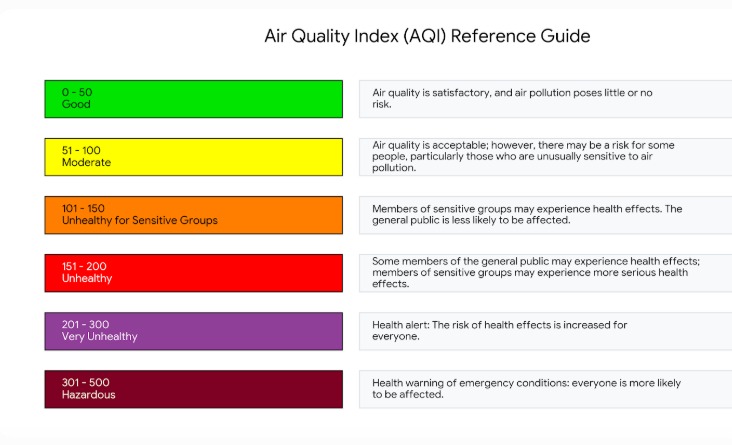
Below is the Air Quality Index (AQI) reference table and guide based on the U.S. Environmental Protection Agency (EPA) standards.
Key Takeaways for Each Level
- Good (0 to 50): It’s a great day to be active outdoors!
- Moderate (51 to 100): Extremely sensitive individuals should consider cutting back on prolonged outdoor activity.
- Unhealthy for Sensitive Groups (101 to 150): People with lung disease (like asthma), heart disease, children, pregnant women, and older adults should reduce prolonged or heavy outdoor activities.
- Unhealthy (151 to 200): Everyone should reduce prolonged or heavy exertion outdoors. Sensitive groups should avoid prolonged outdoor activity altogether.
- Very Unhealthy (201 to 300): Everyone should significantly limit outdoor activity. Sensitive groups should avoid all physical activity outdoors.
- Hazardous (301 to 500): Emergency conditions. Everyone should avoid all physical activity outdoors and remain indoors as much as possible.
How to Protect Your Lungs from Wildfire Smoke
You don’t have to feel helpless when the skies turn orange. Taking a few proactive steps can drastically reduce your exposure to toxic fine particles:
- Check the AQI Daily: Treat the Air Quality Index like your local weather report. Before heading out for a run or letting your kids play outside, check platforms like AirNow.gov or local air quality apps.
- Keep Your Indoor Air Clean: When smoke levels spike, seal your house. Close all windows and doors. Run your air conditioner on “recirculate” mode so you aren’t pulling smoky air from the outside.
- Deploy HEPA Filters: High-Efficiency Particulate Air (HEPA) purifiers are highly effective at trapping PM2.5. Place them in the rooms where you spend the most time, like your bedroom or living room. (If you’re on a budget, look up how to build a DIY “Corsi-Rosenthal Box” using a box fan and MERV-13 furnace filters).
- Mask Up Safely: Standard cloth masks and blue surgical masks do absolutely nothing to stop microscopic PM2.5 particles. If you must go outside when the AQI is in the orange or red zones, wear a well-fitted N95 or KN95 respirator.
- Postpone Outdoor Exertion: Heavy breathing during exercise pulls particles deeper into your lungs. On smoky days, swap your outdoor run for an indoor workout.
Wildfires are a reminders of our changing climate and the power of nature. While we can’t always control where the wind blows the smoke, we can control how we prepare. Keep an eye on the sky, track your local AQI, and keep your indoor spaces safe.
For additional reading and resources on how to cope with loss and grief after a wildfire, click here.


Thanks for putting this together. Clear, actionable advice that can help people protect themselves during wildfire season. Luckily this is usually not an issue in Switzerland.
This is such a terrifying time and you have provided some very helpful tips on how to protect our lungs. Eastern Canada really is experiencing the worst right now and in Western Canada it is getting worse with the extreme high temperatures and lack of rain. I didn’t realize there were over 850 active wildfires in Canada… It is hard to stay positive.
This information, how to protect your lungs, is lifesaving. Isn’t it scary how these things are now becoming more common, these natural disasters, the extreme heat and the wild fires! Stay safe out there!
The orange skies sound frightening, especially when the smoke can travel so far from the actual fires. I experienced something like this, I think in 2017, in Tropea, Italy. I was very scared. Treating the Air Quality Index like a daily weather forecast is such a practical tip, and one I don’t think enough of us would consider.
Thanks for this. This is very helpful information. We have a hike planned today in upstate NY, along with an outdoor festival for the next 3 days. Yikes! Need to take all of this into consideration.
It has been bad, and the season has only started. We live in the Greater Toronto Area and two days ago the sky was orange – it made everything look like sepia. It was so strange. Within minutes of being out, I could feel my eyes and throat begin to burn a little.
What great information to share Danwil! It’s so scary with this extremely high heat and no rain in sight for many areas. While the sky photo looks awesome, we all have to be diligent and take the drought and high heat seriously for the safety of our health and the possibility of wild fires.